Read a concept or board texture.
Training Lab
Study, practice, review, and track your decision leaks.
Use Smart Score drills, range training, hand-review templates, leak reports, board texture study, pot odds practice, player type review, hand ranking, and pot odds calculation in one place.
Tools are for offline hand review, rules learning, and strategy training only. They do not provide real-money betting advice, real-time play assistance, or platform referrals. Progress is stored only in this browser.
Texas Hold'em Hand Rank CheckerEnter 5 to 7 cards and identify the best five-card poker hand.Texas Hold'em Pot Odds CalculatorCalculate the minimum equity required to call a bet.Daily Hand TrainerPractice one poker decision point with a clear review of baseline and exploit adjustment.Preflop Range FinderReview basic open, defense, and 3-bet ranges by position.Pot Odds TrainerSolve repeated pot odds drills and build fast required-equity intuition.Poker Player Type TestIdentify whether your current leak is calling too much, folding too much, over-bluffing, result orientation, or half-GTO thinking.Preflop Range Trainer 2.0Practice preflop decisions, edit local 13x13 matrices, compare custom ranges with beginner baselines, and run a daily preflop challenge.Hand Review BuilderCreate a structured offline hand-review template from stack, position, board, action line, and opponent type.Smart Score Leak DashboardReview your local training score, recurring mistake labels, and next recommended drills.Board Texture AtlasStudy common flop families and connect board texture to range advantage, c-bet frequency, and sizing discipline.
Anonymous Hand Submission GuideBuild a privacy-safe review draft locally before Analyze Lite.
Weekly Training ChallengeFollow a seven-action study loop and copy a local share summary.
Drill Pack SEO LibraryOpen focused training pages for the main Smart Score packs.
Training Library BlueprintReview the Phase 5 taxonomy, coverage targets, and quality rules.
Expansion-Ready
Next training libraries are already mapped.
The current static data model is prepared for larger drill packs, editable ranges, and future local dashboards without changing the education-only boundary.
| Future Track | Target | Tags |
|---|---|---|
| 3-Bet Pots IP and OOP | 40+ spots | 3-bet pot / SPR / overpair / TPTK / ace-high board |
| River Decision Lab | 45+ spots | overbet / thin value / bluff catcher / blocker / check-raise |
| Multiway and Tournament Basics | 35+ spots | multiway / ICM basics / short stack / push fold / bubble |
| Live Exploit Library | 45+ spots | calling station / nit / maniac / regular / over-folder |
| Editable Range Matrix | 20+ spots | range matrix / custom range / preflop challenge / local save |
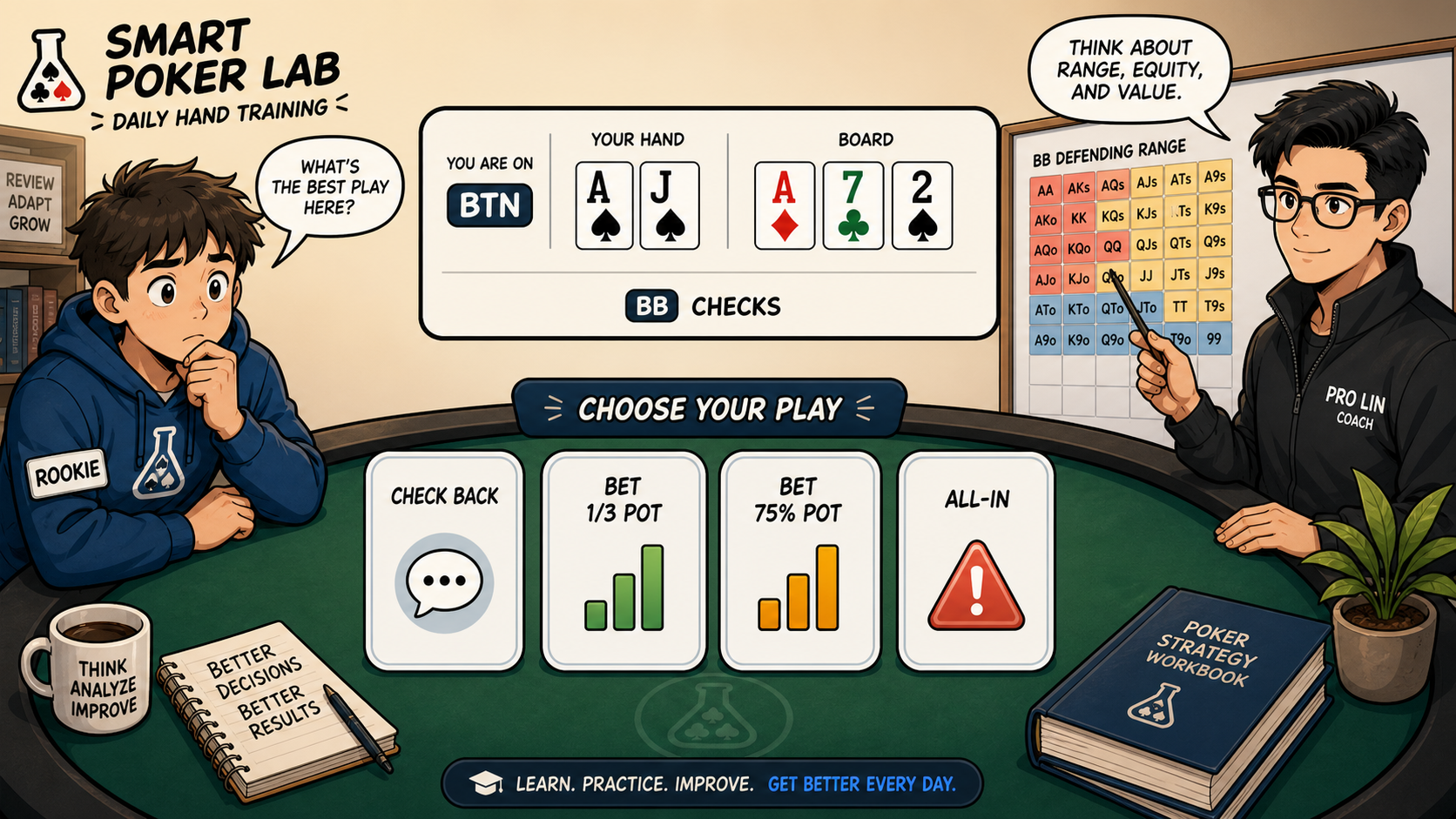
15-Minute Daily Workout
Train one main hand, review the score tier, tag the mistake, then move into a small related drill. Offline study only; not real-time play assistance.
Range Trainer
Practice one preflop decision at a time, edit a local 13x13 range, and compare your version against a conservative beginner baseline. Offline study only. Not a solver. Not real-time play assistance. Progress and custom ranges stay in local browser storage only.
Daily Preflop Discipline
Five range decisions, one clean habit.
Today's challenge is generated locally from the current drill library and saved only in this browser.
Range Comparison
Choose a matrix to compare your browser-local custom range with the beginner baseline.
| Hand Bucket | Baseline | Your Range | Coach Cue |
|---|---|---|---|
| Pairs | 0 | 0 | Pairs need position, stack depth, and response plans. |
| Suited Ax | 0 | 0 | Suited aces gain value from blockers and nut-flush potential. |
| Offsuit Broadways | 0 | 0 | Watch domination when ranges behind are strong. |
Range-vs-Range Shape Preview
Select or edit a matrix to compare broad range shape against a common opposing range. This is a teaching visual, not solver equity.
Smart Score
0
Complete a range decision to create a score.
Hand Review Builder
Turn a messy hand memory into a structured review. Nothing is uploaded; the draft stays in this browser.
Your structured review will appear here.
Use it after a session, away from the table, to separate baseline strategy from exploit adjustment.
Smart Score and Leak Dashboard
Review your browser-local Study, Practice, Analyze, drill-pack, and 30-day plan activity. This report is a study guide, not a claim about real-money performance.
Your first 3-minute loop
Complete 1 Daily Hand, 3 Pot Odds drills, and 1 Analyze Lite note. After that, this page turns into your first Smart Score training portrait with a top leak and next drill.
Average Smart ScoreNo data
Complete a scored drill first.
Training Decisions0
Practice and Analyze events in this browser.
30-Day Plan0 / 30
Local checkoff progress.
Study Spots0
Study Mode views saved locally.
Analyze Reports0
Saved local hand reports.
Routine Score0%
Build the full loop.
Current Streak0
Consecutive Practice scores at 80 or higher.
Best Streak0
Best browser-local Practice streak.
Review Queue0
Low-score spots ready for replay.
7-Day Rhythm0
Training actions in the last 7 days.
Study Mastery0
Study Mode spots marked as studied.
Study Queue0
Study spots routed into Practice.
Dashboard 2.0
Strength map, badges, spaced review, and share card.
Skill RadarTraining dimensions
Complete scored drills to build your radar.
BadgesHabit milestones
Complete one scored drill to unlock badges.
Spaced ReviewDue low-score spots
No low-score reviews due yet.
Weekly Coach7-day training rhythm
Complete one Study spot, one Practice decision, and one Analyze report to start the weekly coach.
Drill PacksPack progress
No drill-pack progress yet.
Weakest PackWhere to focus next
Practice one drill pack to unlock pack focus.
Study QueueSent from Study Mode
No Study spots queued for Practice yet.
Session FocusPractice session state
No Practice session data yet.
ContinuityLearning loop health
Build activity in Study, Practice, Analyze, and Plan.
Training LoopAction mix
Score TrendRecent scored decisions
No scored decisions yet.
Leak PrioritiesWhat to train next
RecommendationNext best drill
Next training recommendation
Answer a Daily Hand or Range Trainer spot to unlock a personalized suggestion.
Next ActionsThree-step training prescription
Next 5 DecisionsPack prescription
Complete one scored drill to unlock a five-spot routine.
Recent ActivityLatest local events
No local activity yet.
Analyze ReportsSaved hand reviews
No saved Analyze reports yet.
Browser-Local Backup
Your progress lives in this browser.
Export a backup before clearing browser data or switching devices. Importing a backup replaces only Smart Poker Lab local training keys. Optional cloud sync is a future feature, not active today.
Board Texture Atlas
A simplified study report for common flop families. It teaches pattern recognition, not solver output.
| Texture | Baseline Read | Sizing Bias | Beginner Risk |
|---|---|---|---|
| High-card dry board | The preflop raiser often has range advantage and can use frequent small bets. | Choose size by range shape, board texture, and target hands. | Only betting when holding a king. |
| Low connected wet board | The big blind connects with more pairs, two pairs, straights, and draws. C-bet frequency should drop. | Choose size by range shape, board texture, and target hands. | Auto-c-betting because Hero raised preflop. |
| Paired high-card board | The raiser can pressure many pocket pairs with small bets, but must protect checking range too. | Choose size by range shape, board texture, and target hands. | Thinking nobody has an ace and betting every hand too large. |
| Broadway connected board | Both ranges can hold strong top pairs, straights, two pairs, and high-equity draws. Sizing must be more selective. | Choose size by range shape, board texture, and target hands. | Treating top pair as automatically safe. |
| A-high dry board | The raiser often has many strong Ax and can small-bet frequently. | Small size often applies enough pressure. | Betting only when holding an ace. |
| K-high dry board | The raiser often owns high-card density and can use small range pressure. | Small range bets are common teaching baseline. | Checking every missed broadway. |
| Q/J high connected board | Both ranges connect with top pair, two pair, straights, and strong draws. | Use more selective sizing and fewer automatic bets. | Treating one pair as locked value. |
| Paired low board | Raiser can pressure, but defender has more natural trips than on high-card boards. | Small bets and protected checks both matter. | Thinking paired means nobody has anything. |
| Monotone board | Ranges compress because one suit controls many continues and blockers matter. | Smaller, more cautious sizes are easier to manage. | Ignoring suit blockers. |
| Two-tone dry board | A high-card advantage remains, but flush draws add more continues. | Small-to-medium sizes target worse Ax and draws. | Using rainbow-board logic with no draw adjustment. |
| Broadway dry board | Raiser has strong high-card density, but both players can hold top-pair classes. | Small or medium bets need clear targets. | Treating every king as equal. |
| Low disconnected board | Raiser has overcards, defender has many pairs and small-board connects. | Small bets can deny equity but should not be automatic. | Assuming two overcards always mean pressure. |
K72 rainbow
Range: The preflop raiser often has range advantage and can use frequent small bets.
Nut advantage: Compare which player has more sets, two pair, straights, flushes, or top-kicker value.
Baseline: The preflop raiser often has range advantage and can use frequent small bets.
Calling-station adjust: Reduce weak bluffs and value bet hands that worse holdings can call.
Beginner trap: Only betting when holding a king.
Training prompt: Ask who owns more strong Kx, overpairs, and high-card pressure.
Study related page876 two-tone
Range: The big blind connects with more pairs, two pairs, straights, and draws. C-bet frequency should drop.
Nut advantage: Compare which player has more sets, two pair, straights, flushes, or top-kicker value.
Baseline: The big blind connects with more pairs, two pairs, straights, and draws. C-bet frequency should drop.
Calling-station adjust: Reduce weak bluffs and value bet hands that worse holdings can call.
Beginner trap: Auto-c-betting because Hero raised preflop.
Training prompt: Ask who owns more nutted and high-equity continues.
Study related pageAA5 rainbow
Range: The raiser can pressure many pocket pairs with small bets, but must protect checking range too.
Nut advantage: Compare which player has more sets, two pair, straights, flushes, or top-kicker value.
Baseline: The raiser can pressure many pocket pairs with small bets, but must protect checking range too.
Calling-station adjust: Reduce weak bluffs and value bet hands that worse holdings can call.
Beginner trap: Thinking nobody has an ace and betting every hand too large.
Training prompt: Ask how many Ax each range keeps and what worse hands continue.
Study related pageQJT two-tone
Range: Both ranges can hold strong top pairs, straights, two pairs, and high-equity draws. Sizing must be more selective.
Nut advantage: Compare which player has more sets, two pair, straights, flushes, or top-kicker value.
Baseline: Both ranges can hold strong top pairs, straights, two pairs, and high-equity draws. Sizing must be more selective.
Calling-station adjust: Reduce weak bluffs and value bet hands that worse holdings can call.
Beginner trap: Treating top pair as automatically safe.
Training prompt: Ask which turns are good for barreling and which complete too many draws.
Study related pageA72 rainbow
Range: The raiser often has many strong Ax and can small-bet frequently.
Nut advantage: Strong Ax and sets are distributed by preflop ranges.
Baseline: The raiser often has many strong Ax and can small-bet frequently.
Calling-station adjust: Value bet Ax more; bluff less against callers.
Beginner trap: Betting only when holding an ace.
Training prompt: Name worse Ax that call before choosing size.
Study related pageK72 rainbow
Range: The raiser often owns high-card density and can use small range pressure.
Nut advantage: Defender has sets but fewer strong Kx.
Baseline: The raiser often owns high-card density and can use small range pressure.
Calling-station adjust: Remove weak air versus sticky callers.
Beginner trap: Checking every missed broadway.
Training prompt: Compare QJs and KQ on the same board.
Study related pageQJT two-tone
Range: Both ranges connect with top pair, two pair, straights, and strong draws.
Nut advantage: Nut advantage is shared and turn cards shift quickly.
Baseline: Both ranges connect with top pair, two pair, straights, and strong draws.
Calling-station adjust: Value bet clearly; avoid weak bluffs into callers.
Beginner trap: Treating one pair as locked value.
Training prompt: List which turn cards complete too much.
Study related page772 rainbow
Range: Raiser can pressure, but defender has more natural trips than on high-card boards.
Nut advantage: Trips are important even when rare.
Baseline: Raiser can pressure, but defender has more natural trips than on high-card boards.
Calling-station adjust: Value small pairs cautiously versus stations.
Beginner trap: Thinking paired means nobody has anything.
Training prompt: What hands continue to a small bet?
Study related pageK83 monotone
Range: Ranges compress because one suit controls many continues and blockers matter.
Nut advantage: Nut flush ownership depends on suited preflop combos.
Baseline: Ranges compress because one suit controls many continues and blockers matter.
Calling-station adjust: Value worse pairs carefully; avoid big pure bluffs.
Beginner trap: Ignoring suit blockers.
Training prompt: Does Hero hold the key suit?
Study related pageA72 two-tone
Range: A high-card advantage remains, but flush draws add more continues.
Nut advantage: Strong Ax and nut-flush draws shape future streets.
Baseline: A high-card advantage remains, but flush draws add more continues.
Calling-station adjust: Charge draws and weak Ax, but keep sizes callable.
Beginner trap: Using rainbow-board logic with no draw adjustment.
Training prompt: Which turns are bad for a thin value hand?
Study related pageKQ4 rainbow
Range: Raiser has strong high-card density, but both players can hold top-pair classes.
Nut advantage: Two-pair and top-pair kicker quality matter.
Baseline: Raiser has strong high-card density, but both players can hold top-pair classes.
Calling-station adjust: Value stronger Kx; avoid thin bets too large.
Beginner trap: Treating every king as equal.
Training prompt: Which worse hands call KJ here?
Study related page942 rainbow
Range: Raiser has overcards, defender has many pairs and small-board connects.
Nut advantage: Sets sit more naturally in defender range.
Baseline: Raiser has overcards, defender has many pairs and small-board connects.
Calling-station adjust: Reduce air versus pair-curious callers.
Beginner trap: Assuming two overcards always mean pressure.
Training prompt: Which range has more pairs?
Study related pagePreflop Range Finder
Choose a position and review basic open, defense, and 3-bet training ranges. These are study baselines, not fixed answers.
| Position | Default Job | Pressure Risk |
|---|---|---|
| UTG / MP | Enter with durable hands and avoid domination | Too many players can 3-bet or call behind |
| CO / BTN | Use position to widen playable opens | Blinds can fight back if you steal too much |
| SB / BB | Respect out-of-position realization | Good price does not make every hand profitable |
Pot Odds Trainer
Solve short pot odds drills until required equity becomes automatic.
Player Type Test
Answer 10 questions to identify your current training tendency.
Hand Rank Checker
Enter 5 to 7 cards and find the best five-card poker hand. This tool teaches hand rankings, not equity.
Format: As Ks Qs Js Ts. Ranks: A/K/Q/J/T/9. Suits: s/h/d/c.
Pot Odds Calculator
Enter the current pot, villain bet, and call amount to calculate the required equity.
Formula: required equity = call amount / (current pot + villain bet + call amount)
FAQ
Which tools are included?
Daily Hand Trainer, Preflop Range Trainer, Hand Review Builder, Leak Dashboard, Board Texture Atlas, Preflop Range Finder, Pot Odds Trainer, Player Type Test, Hand Rank Checker, and Pot Odds Calculator.
Do I need an account?
No. Tools run in the browser, and training progress is saved locally only.
Can these tools be used during real-time play?
No. They are for offline rules learning, math training, and hand review education only.